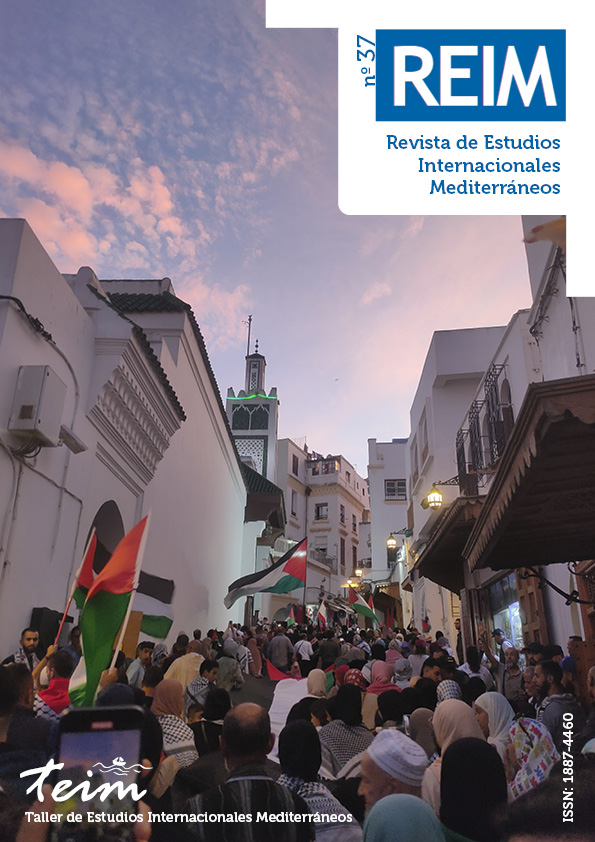
Flags, Watermelons and Other Fruits: The National Symbols of the Palestinian Motherland

Keywords:
Palestine, watermelon, palestinian symbols, Palestinian nationalism, palestinian motherlandCopyright (c) 2024 Clarisa Danae Fonseca Azuara

This work is licensed under a Creative Commons Attribution-NonCommercial 4.0 International License.
Abstract
This article examines the national symbols of the Palestinian motherland, highlighting their diversity and significance beyond conventional expressions due to the prohibition and censorship imposed by the Israeli occupation. We explore their historical rootedness and emotional connection to the Palestinian community. In addition, we analyze the impact of the ban on the construction of national narratives and the crucial role of women in the preservation of these symbols. The study reveals the vitality and dynamism of Palestinian national symbols in a context of adversity and censorship.
Downloads
References
ABUFARHA, Nasser. (2008): “Land of symbols: Cactus, poppies, orange and olive trees in Palestine”, Identities: Global Studies in Culture and Power, 15 (3), pp. 343-368. DOI: https://doi.org/10.1080/10702890802073274
ABOUBAKR ALKHAMMASH, Farah. (2014): The Folktale as a Site of Framing Palestinian Memory and Identity in “Speak, Bird, Speak again” and “Qul Ya Tayer” (Tesis doctoral). The University of Manchester, Reino Unido, disponible en https://www.escholar.manchester.ac.uk/jrul/item/?pid=uk-ac-man-scw:240409
ADALAH (2022): “Q & A on the Legality of Waving the Palestinian Flag”, Press Releases, disponible en https://www.adalah.org/en/content/view/10628 [consulta: 1 de febrero de 2024].
ALLEN, Lori (2009): “Mothers of martyrs and suicide bombers: The gender of ethical discourse in the second Palestinian intifada”, The Arab Studies Journal, vol. 17, n° 1, pp. 32-61.
AFIFA, Laila (9 de noviembre de 2023): “Pro-Palestinian Protestors Distribute Watermelons in Front of US Embassy Today”, Tempo, disponible en https://en.tempo.co/read/1794780/pro-palestinian-protestors-distribute-watermelons-in-front-of-us-embassy-today [consulta: 10 de abril de 2024].
ANDERSON, Benedict (1993): Comunidades imaginadas: Reflexiones sobre el origen y la difusión del nacionalismo (1ª ed.), México, Fondo de Cultura Económica.
BARZILY, Amnon (1985): “Danger: A Painter”, Journal of Palestine Studies, vol. 14, n° 3, pp. 176-179. DOI: https://doi.org/10.1525/jps.1985.14.3.00p0187u
BEYNON, Mat: “All rise for the Palestinian anthem”, The World, 30 de mayo de 2010, disponible en https://theworld.org/stories/2017/03/10/all-rise-palestinian-anthem [consulta: 1 de abril de 2024].
CHARIF, Maher: “The Palestinian Flag”, Interactive Encyclopedia of the Palestinian Question, disponible en https://www.palquest.org/en/highlight/33555/palestinian-flag [consulta: 1 de abril de 2024].
ELIRAZ, Giora, & RAKHMAT, Muhammad (2023): “Israel-Indonesia Relations: An Ongoing Saga of Unrecognition and Backroom Contacts”, en EVRON, Yoram (ed.) Israel-Asia Relations in the Twenty-First Century, Routledge, pp. 216-231. DOI: https://doi.org/10.4324/9781003317142-15
FONSECA AZUARA, Clarisa Danae (2019): “Nación imaginada, nación feminizada: la matria palestina” en Islam y desposesión: resignificar la pertenencia, Ediciones del Oriente y del Mediterráneo, pp. 127-143.
FONSECA AZUARA, Clarisa Danae (2020): “Matria palestina: arte y género en la construcción de una nación sin límites”. Tesis Doctoral. Universidad Autónoma de Madrid.
GEISLER, Michael (2005): National symbols, fractured identities: Contesting the national narrative, Vermont, Middlebury College Press.
GIJÓN MENDIGUTÍA, Mar (2015): Historia del movimiento de mujeres en Palestina, Navarra, Txalaparta.
GILLEN, Devin (2023): “Shireen Abu Akleh”, History in the Making, vol. 16, n° 1, pp. 401- 442.
GÓMEZ GARCÍA, Luz (2019): Diccionario del Islam e islamismo, Madrid, Trotta.
HADI, Mahdi Abdul (2011): Jerusalem of art, Jerusalén, Palestinian Academic Society of International Affairs.
HAWARI, Yara (2021): “Why Israel is so desperate to silence #SaveSheikhJarrah”, Aljazeera, disponible en https://www.aljazeera.com/opinions/2021/6/10/why-israel-is-so-desperate-to-silence-savesheikhjarrah [consulta: 12 de abril de 2024].
HUMAN RIGHTS WATCH (2023): “Meta’s Broken Promises: Systemic Censorship of Palestine Content on Instagram and Facebook”, disponible en https://www.hrw.org/report/2023/12/21/metas-broken-promises/systemic-censorship-palestine-content-instagram-and [consulta: 12 de marzo de 2024].
IMSEIS, Ardi (2021): “On membership of the United Nations and the State of Palestine: A critical account”, Leiden Journal of International Law, 34(4), pp. 855-878. DOI: https://doi.org/10.1017/S0922156521000418
KANAANA, Sharif (1990): “Humor of the Palestinian "Intifada"”, Journal of Folklore Research, 27, n° 3, pp. 231-240.
KARAMAH, Samah (2023) “Sheikh Jarrah Issue in the Context of the Palestinian Resistance against the Israeli Occupation: A Game Changer”, Journal of Islamic Jerusalem Studies, 2023, vol. 23, n° 2, pp. 213-238. DOI: https://doi.org/10.31456/beytulmakdis.1353928
KARRAY, Raouf (2013) : “Dar al-fata al-Arabi : Créer et transmettre le patrimoine culturel Arabe”, disponible en http://takamtikou.bnf.fr/dossiers/dossier-2013-patrimoine-et-transmission/dar-al-fata-al-arabi-cr-er-et-transmettre-le-patrim [consulta: 21 septiembre 2018].
KHALIDI, Rashid (2010): Palestinian identity: The construction of modern national consciousness, Nueva York, Columbia University Press.
KHOURI, Kristine & SALTI, Rasha (2019): “Past Disquiet: Artists, International Solidarity and Museums in Exile”, Museum of Modern Art in Warsaw.
MASSAD, Joseph (2003): “Liberating songs: Palestine put to music”, Journal of Palestine Studies, vol. 32, no 3, pp. 21-38. DOI: https://doi.org/10.1525/jps.2003.32.3.21
NAKHLEH, Khalil (2011): “Yawm al-Ard (Land Day)” en ROUHANA, Nadim, The Palestinians in Israel: Readings in History, Politics and Society, 2011, pp. 83-89.
MASALHA, Nur (2008): “Remembering the Palestinian Nakba: commemoration, oral history and narratives of memory”, Holy Land Studies, vol. 7, n° 2, pp. 123-156. DOI: https://doi.org/10.3366/E147494750800019X
PODEH, Elie (2011): “The symbolism of the Arab flag in modern Arab states: between commonality and uniqueness”, Nations and Nationalism, 2011, vol. 17, n° 2, pp. 419-442. DOI: https://doi.org/10.1111/j.1469-8129.2010.00475.x
SACA, Iman (2006): Embroidering identities: A century of Palestinian clothing, Chicago, The Oriental Institute Chicago.
SAADI, Ahmad., y ABU-LUGHOD, Lila (2017): Nakba Palestina, 1948, y los reclamos de la memoria, Buenos Aires, Canaán.
SAID, Edward. (2000): “Invention, memory, and place”, Critical Inquiry, 26, n° 2, pp. 175-192. DOI: https://doi.org/10.1086/448963
SÁNCHEZ MERA, Ana (2015): “Uso político de los tribunales militares israelíes en el territorio palestino ocupado: mecanismos de represión legal del gobierno de Israel contra movimientos de resistencia no violenta en Palestina”, International Humanities Studies, vol. 2, n° 4, pp. 167- 189.
SHARON, Jeremy (2023): “Activists use images of watermelons to protest police crackdown on Palestinian flags” , The Times of Israel, 22 de junio de 2023, disponible en https://www.timesofisrael.com/activists-use-images-of-watermelons-to-protest-police-crackdown-on-palestinian-flags/ [consulta: 18 de marzo de 2024].
SHERWELL, Tina (1996): “Palestinian costume, the Intifada and the gendering of nationalist discourse”, Journal of Gender Studies, vol. 5, n° 3, pp. 293-303. DOI: https://doi.org/10.1080/09589236.1996.9960651
SHERWELL, Tina (2012): “Jerusalem: City of Dreams”, Jerusalem Quarterly, n° 49.
SOREK, Tamir (2004): “The orange and the ‘Cross in the Crescent’: imagining Palestine in 1929”. Nations and Nationalism, vol. 10, n° 3, pp. 269-291. DOI: https://doi.org/10.1111/j.1354-5078.2004.00167.x
STATE OF PALESTINE “National Anthem”, Embassy of the State Of Palestine – Hungary, disponible en https://en.palestine.hu/palestine-the-holy-land/national-anthem/ [consulta: 1 de abril de 2024].
SOLOMON, Erika (2023): “Germany’s Stifling of Pro-Palestinian Voices Pits Historical Guilt Against Free Speech”, The New York Times, disponible en https://www.nytimes.com/2023/11/10/world/europe/germany-pro-palestinian-protests.html [consulta: 15 de enero de 2024].
SWEDENBURG, Ted (1990): “The Palestinian peasant as national signifier”, Anthropological quarterly, pp. 18-30. DOI: https://doi.org/10.2307/3317957
TAMARI, Salim (1995): “Fading Flags: The Crises of Palestinian Legitimacy”, Middle East Report, n° 194/195, pp. 10-12. DOI: https://doi.org/10.2307/3012781
TROPPER, Johannes (2020): “1988–Palestinian Declaration of Independence: A Tale of Poetry and Statehood”, Austrian Review of International and European Law, vol. 23, pp. 163-182. DOI: https://doi.org/10.1163/15736512-02301009